You secured the identity.
You missed the account.

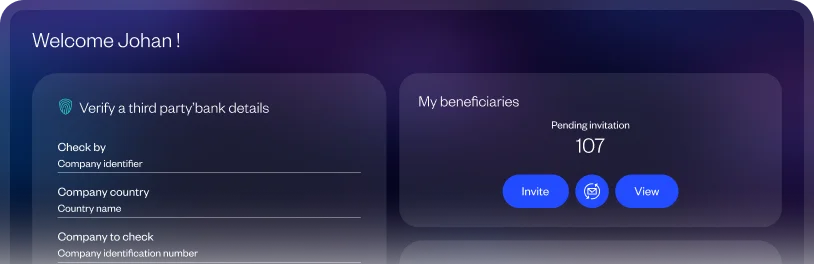
Verify bank account ownership in real time to prevent fraud and payment errors before money moves.

schema

THE BLIND SPOT

Identity verifications don’t prove the account is safe.

Most companies already verify identities through KYC, authentication, and document checks. But fraud often happens later, when a bank detail change looks legitimate, gets processed as usual, and the payment is sent to the wrong account.

blind spot

FROM BLIND SPOT TO SECURED TRANSACTIONS

Know who owns the account before you pay.

Sis ID turns bank account ownership into a clear control point, so your teams can act with confidence before any sensitive payment is released.

schema

A solution built around real industry pain points

Payroll

Secure employee bank account changes

A fraudster impersonates an employee and redirects the next salary payment.

photo corporates

Marketplace payouts

Protect payouts to hosts and sellers

A host’s payout IBAN is changed, and the next payout is redirected.

photo corporates

Freelancer payments

Verify contractor accounts before payouts

Updated bank details are sent by email before an invoice is paid.

photo corporates

Customer refunds

Ensure refunds reach the right account

A fraudster submits new bank details to capture a legitimate refund.

photo corporates

Insurance payouts

Protect indemnity payments from fraud

A large payout is redirected using fraudulent beneficiary details.

photo corporates

Law firms & notaries

Verify accounts before large transfers

Client transfer instructions are modified before a high-value payment is made.

One verification layer,
built for scale across Europe.

+5,000

banks connected

+30

countries

<1s

response time

HOW IT WORKS

One verification. One banking network.
One clear result.

Natural Person verifies whether a bank account belongs to the right individual by verifying identity details against connected banking data sources.

schema

FAQ

Need to learn more?

Yes, and this is one of the most common blind spots in businesses. Payroll teams regularly receive requests from employees to change their bank details — switching banks, opening a joint account, or moving to a neobank. The vast majority of these requests are legitimate, which makes it very difficult to detect fraudulent cases manually. A fraudster who has compromised an employee’s email account can submit a fake request to change bank details and divert the next salary payment, expense reimbursement or dividend. Unlike supplier validation processes — which are generally well-regulated — very few companies have automated checks in place for their own employees’ bank details. Sis ID fills this gap by systematically verifying, before each payroll run, that the bank details associated with an employee do indeed belong to them.

Payments to individuals — freelancers, sole traders, landlords, platform hosts, independent intermediaries — present a specific risk: unlike corporate suppliers, there is no SIRET number or Kbis certificate to cross-check in order to verify the recipient’s identity. A fraudster could impersonate a host on a rental platform, alter their bank details and intercept the next payment. The platform, even if it made the transfer in good faith, remains liable to the legitimate host. Automatic verification of the match between the declared IBAN and the beneficiary’s identity — every time details are updated — is the only scalable solution to this risk. Sis ID performs this verification for both individuals and legal entities, and integrates with the back-offices of platforms, TMS and property management software.

Outgoing payments to customers — refunds, insurance payouts, healthcare reimbursements, and fund transfers by solicitors or notaries — are vulnerable to two distinct types of fraud. Inbound fraud: an individual provides a false IBAN when signing up for a service (such as energy, telecoms or car leasing) to benefit from the service without ever being charged. Outbound fraud: a fraudster impersonates a legitimate customer awaiting a refund or a large transfer, submits false details and intercepts the funds — leaving the company obliged to pay a second time. These risks are particularly acute for regulated professions (solicitors, barristers) whose personal liability may be engaged in the event of a misappropriated transfer, as well as for insurers and mutual societies exposed to subscription fraud via synthetic identities.

An IBAN format check merely verifies that the structure of the character string is valid — it says nothing about the identity of the account holder. IBAN verification as used by Sis ID goes much further: it confirms that the bank account provided does indeed belong to the person declared as the beneficiary, whether they are an employee, a private supplier or a customer. It is this account-identity match that enables the detection of fraud attempts — an IBAN that is technically valid but belongs to a third party or a fraudulent account is blocked before any payment is made. This verification takes place in real time, without any disruption to legitimate beneficiaries, and integrates seamlessly into existing payroll, supplier management or customer onboarding workflows.